We are staying in a guest-house in Bridlington and in the hunt for dinner last night we walked past this little chap. I am yet to see a puffin, or maybe I did see ONE in the Faroe Islands but I can’t be sure – still there’s plenty of time left.
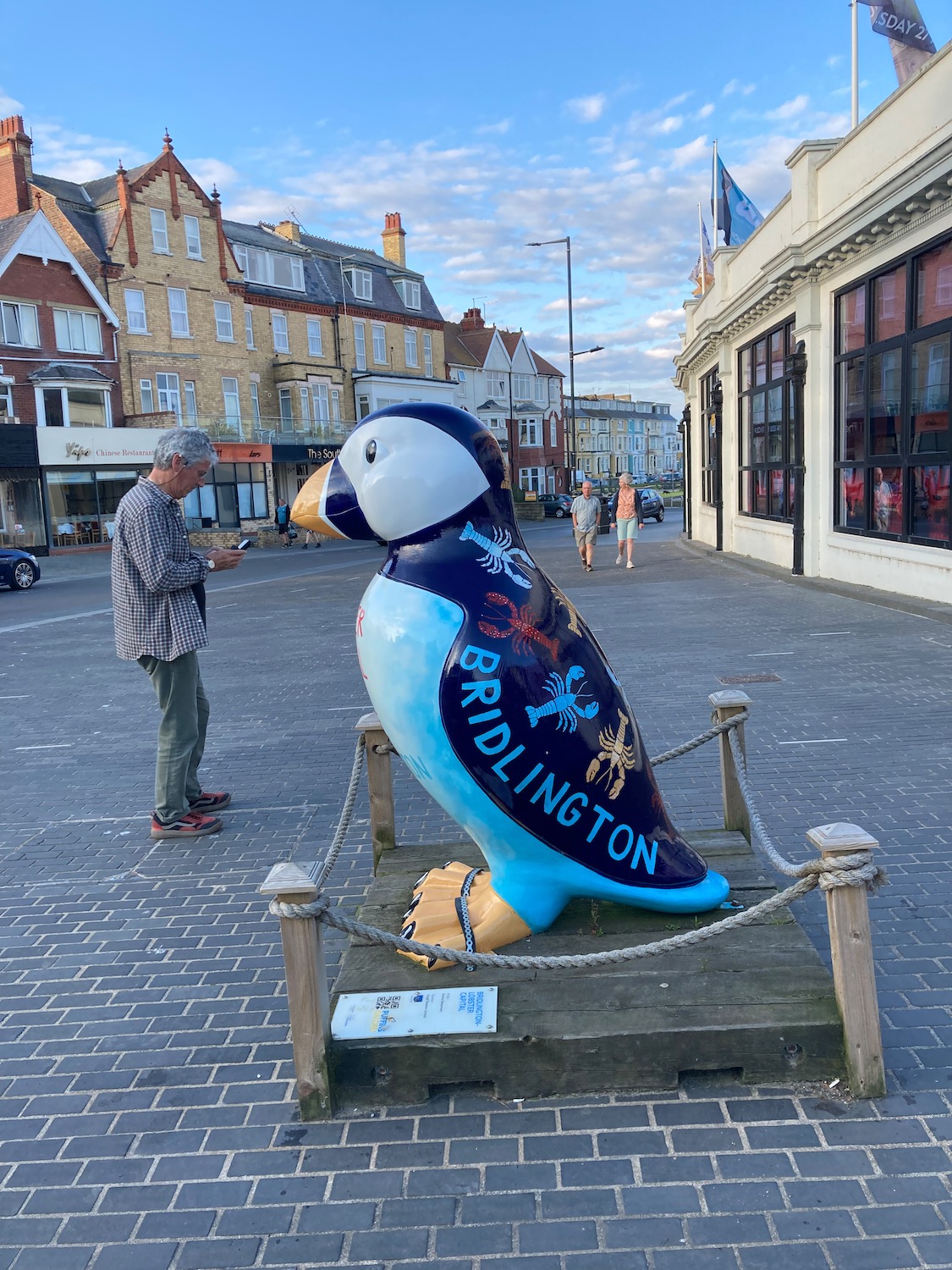
We are staying in a guest-house in Bridlington and in the hunt for dinner last night we walked past this little chap. I am yet to see a puffin, or maybe I did see ONE in the Faroe Islands but I can’t be sure – still there’s plenty of time left.
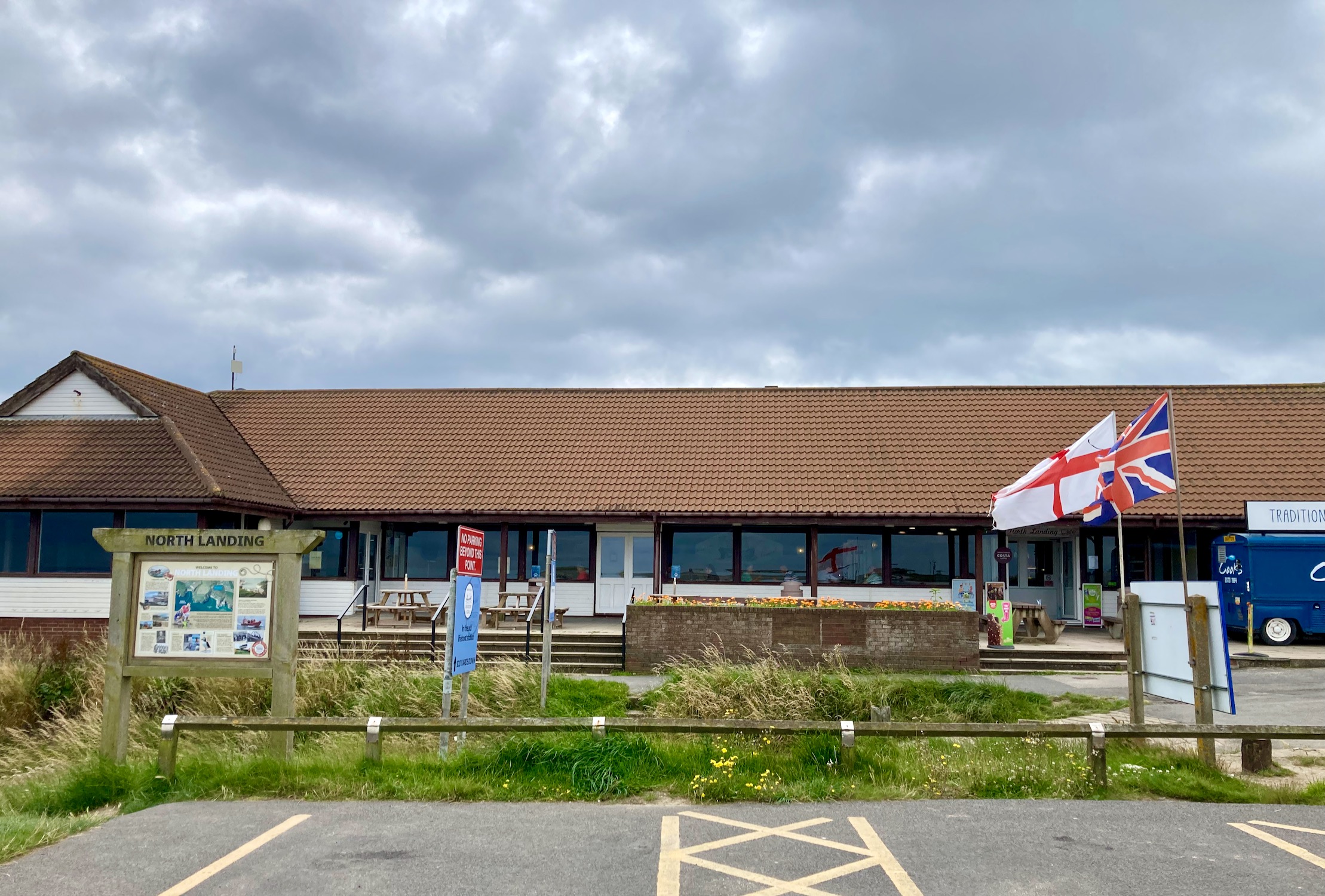
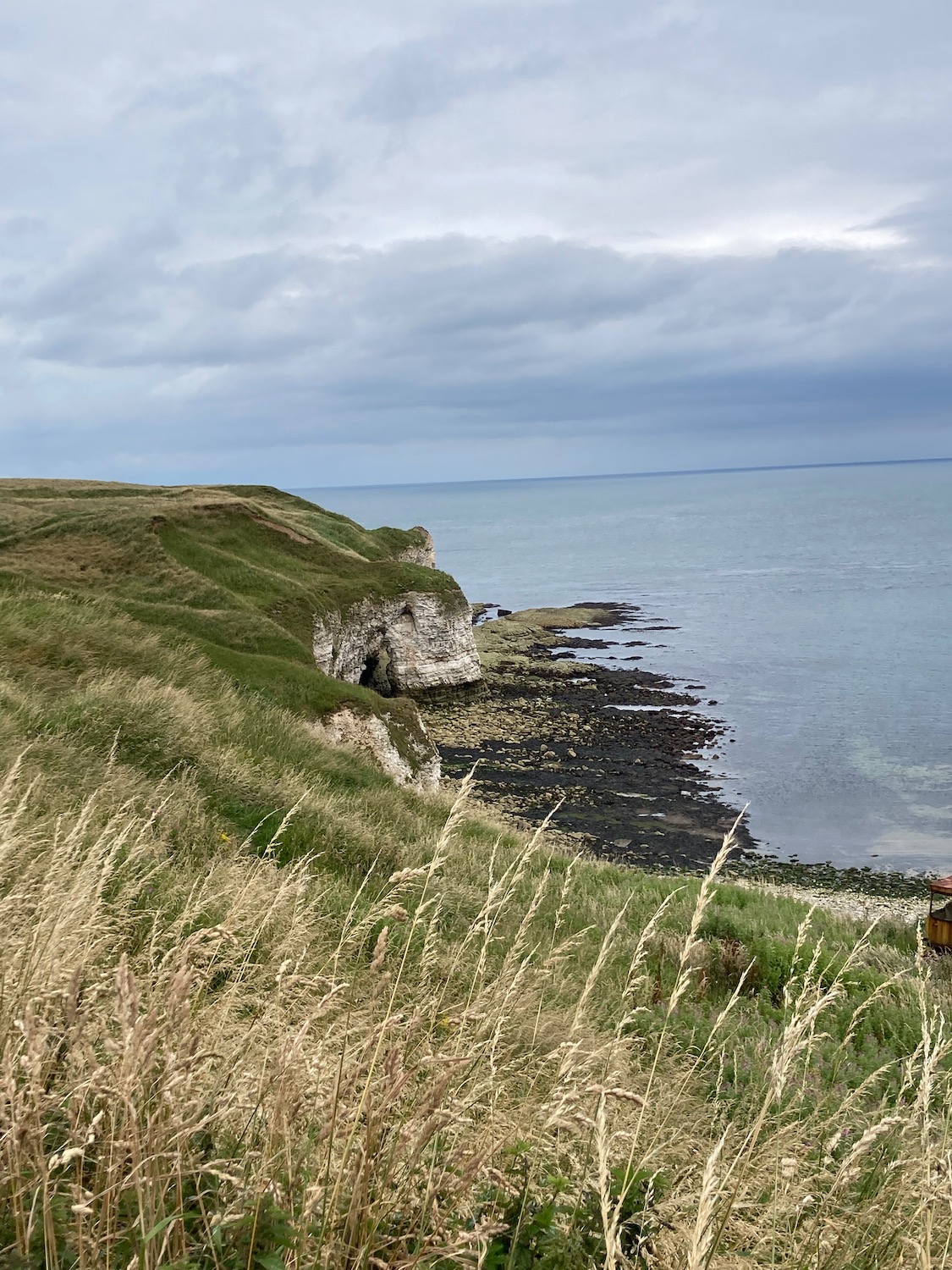
Damian is back and we’re heading south again to North Landing, located on the north side of Flamborough Head. It is part of a nature reserve and as such has a cafe, a carpark, toilets and information boards. The beach is accessed down a steep narrow path but that’s not where we’re going. It’s nice to see chalk cliffs again.
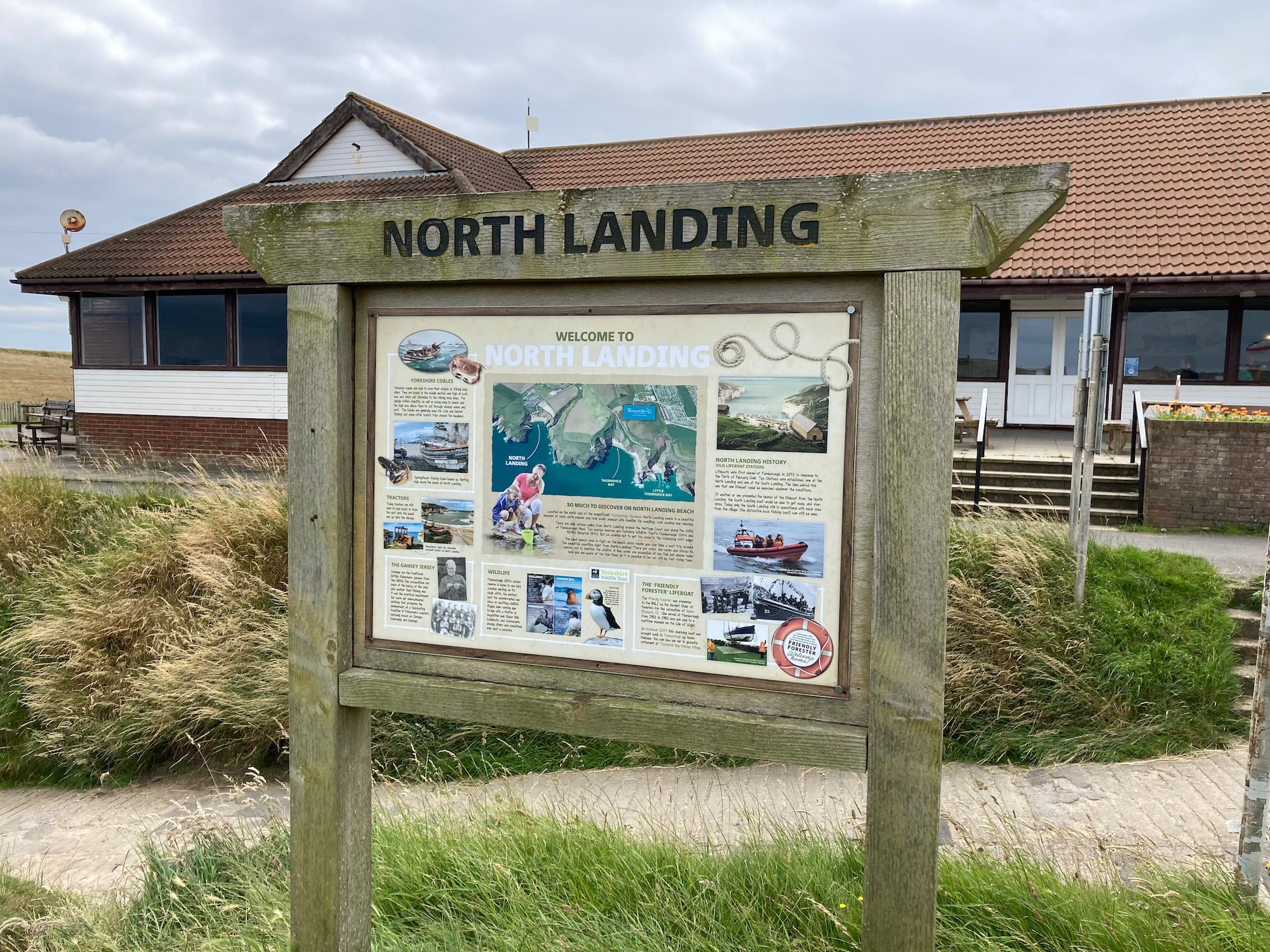

We turn left and follow the cliff path to the neighbouring bay and more information boards.
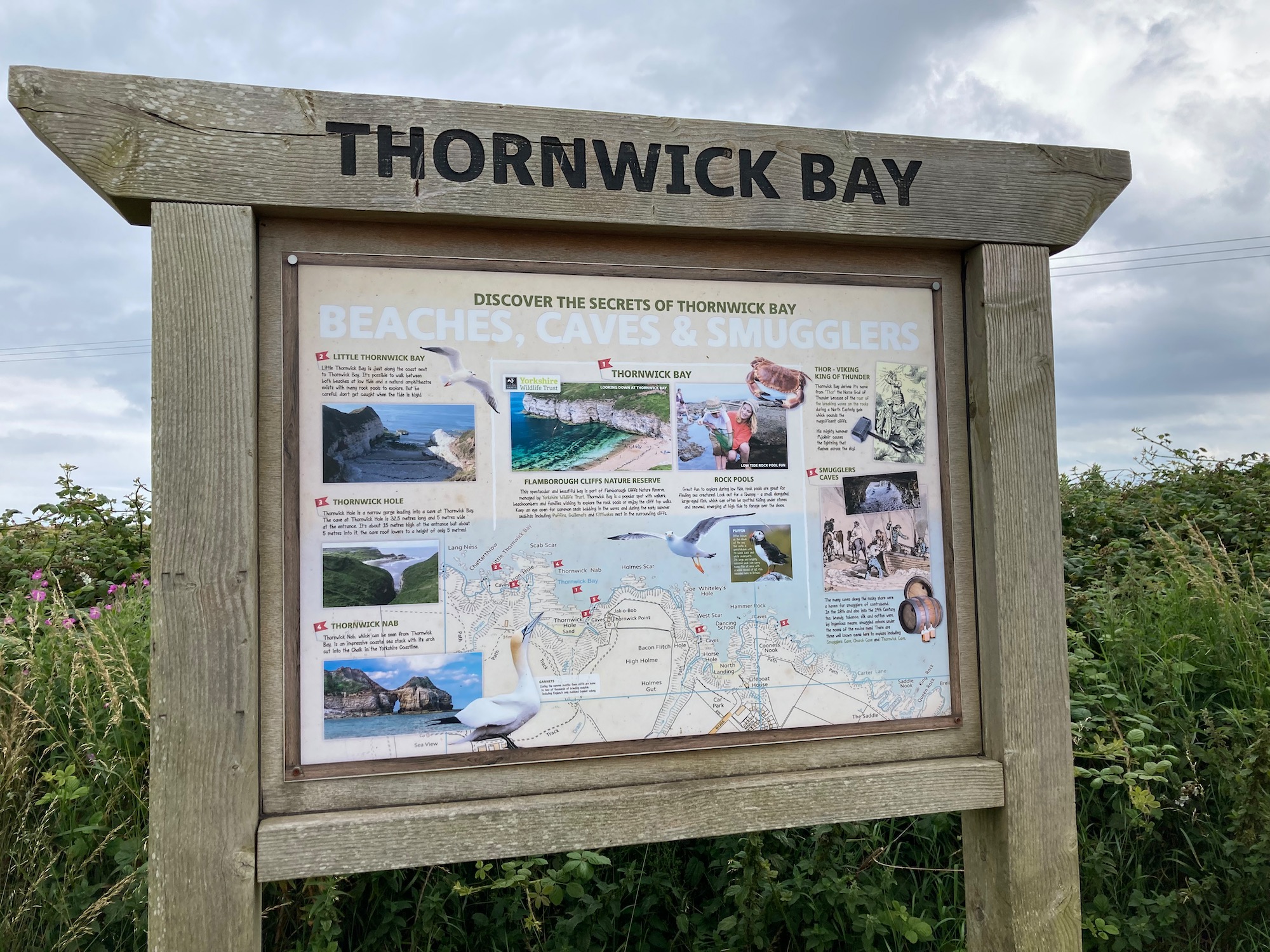
Here is what I found interesting……………
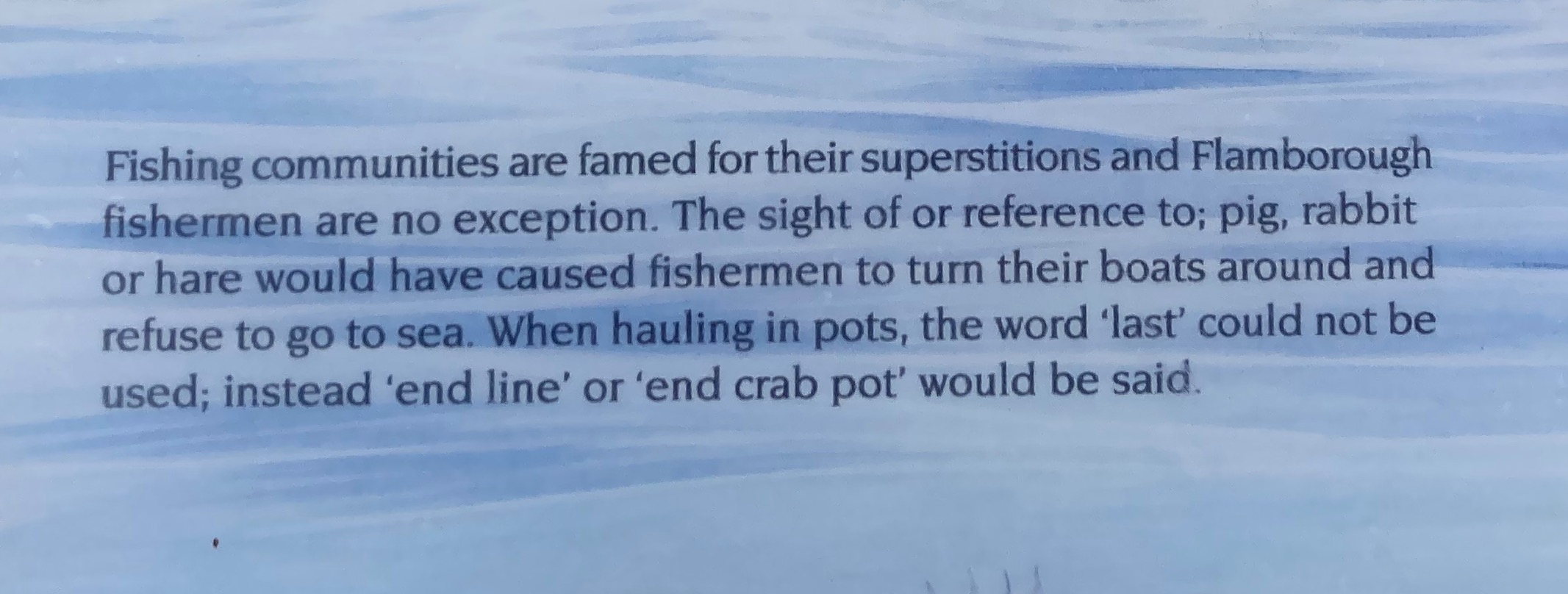
The lobster fishermen used boats based on the shape of the Viking longboats……I like the name.

The cliff path is well marked and easy to walk on and also affords views of quite unusual rock formations – lots of nabs (headlands) and nooks (coves). The sky is also brightening now – it’s going to be a lovely day.

After about three miles we come across what looks very much like a close circuit camera, fenced in on a small promontory and trained on the cliffs opposite us.

It turns out this is part of a seabird research project by the RSPB to study the productivity of Razorbills, Guillemots, Kittiwakes and Gannets. Well, from the racket I’d say these hundreds of birds, ducking and diving around nests on the cliff face, are very productive indeed. It takes me right back to the Grand Hotel only here it’s very much in keeping with the surroundings.
This cliff face is studded with squawking seabirds …………

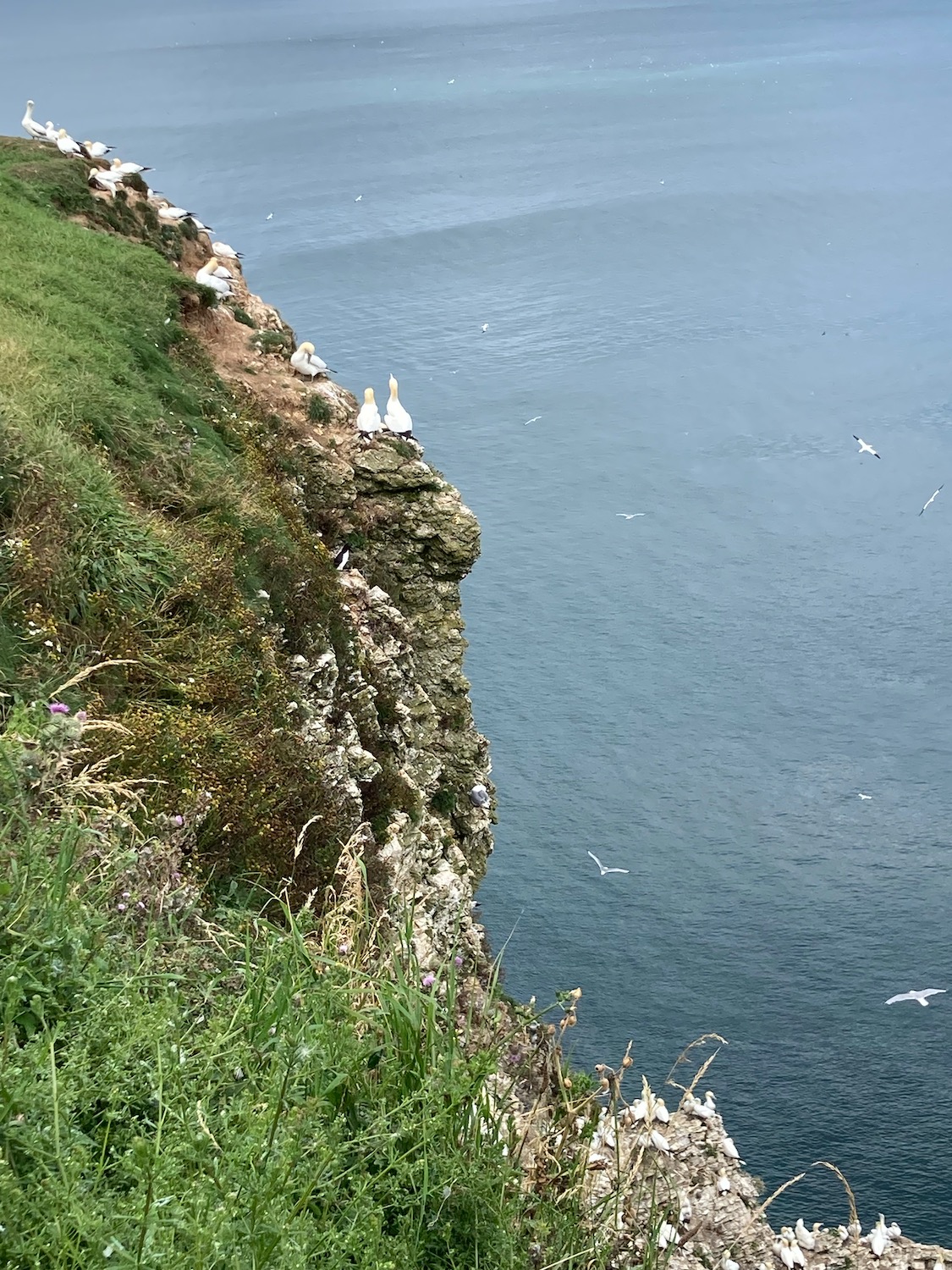
We have reached Bempton Cliffs, which unbeknown to us is the site of one of the UK’s top wildlife spectacles. All along the cliff top viewing galleries have been built and there are quite a few people about, some shouldering cameras with impressive zoom lenses. I later find out there is a visitor centre a short distance inland with road access.
We have of course forgotten to bring the binoculars………………..

We do see lots of sleek gannets gliding through the air and then suddenly diving into the sea – but no blue headed ones.

More information boards describe the practice of “climming” – scaling down the cliff face to raid nests for eggs. I presume the hard hat is to lessen the impact of a sudden dive bombing by angry birds. Brave men…..
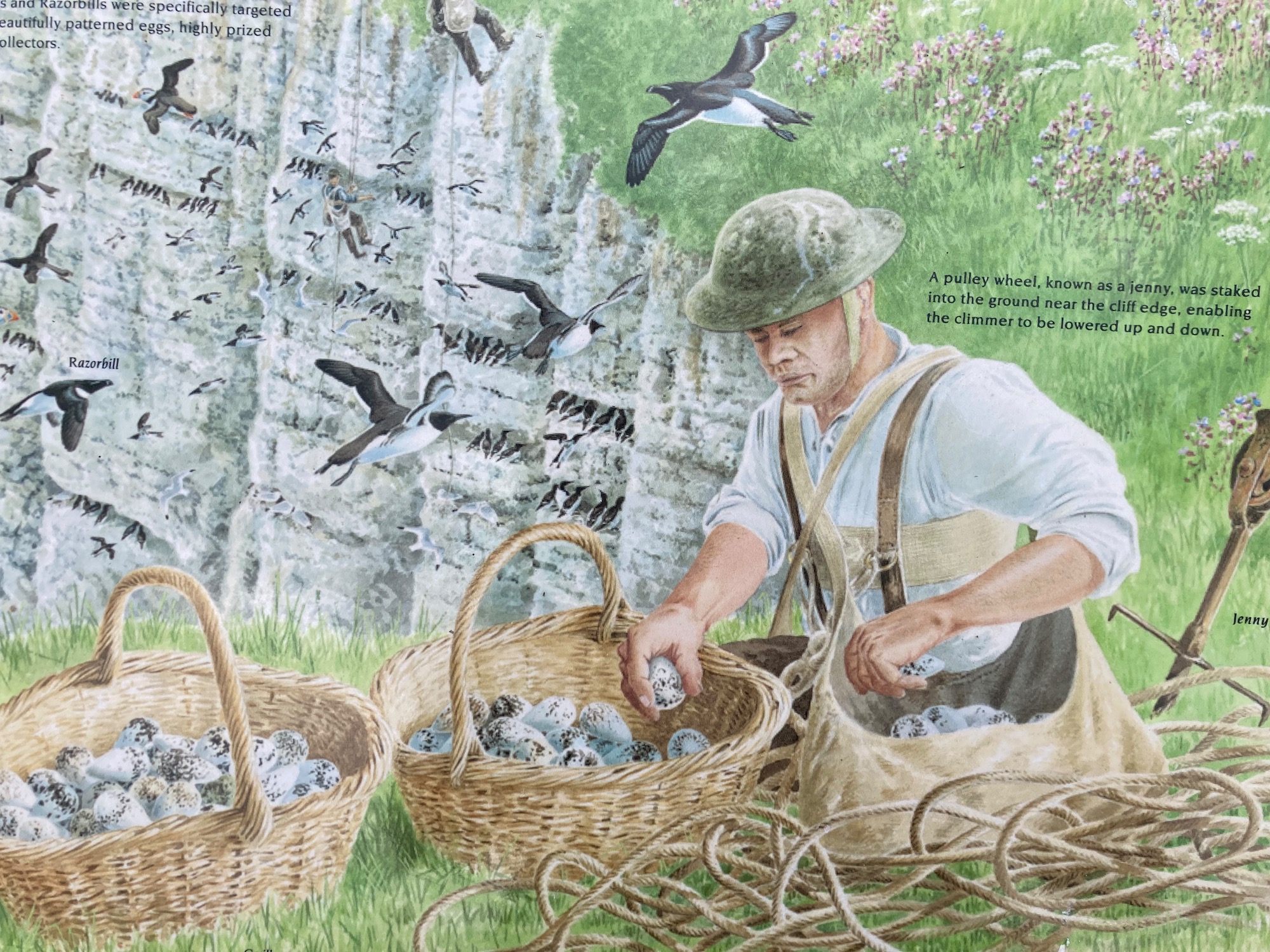
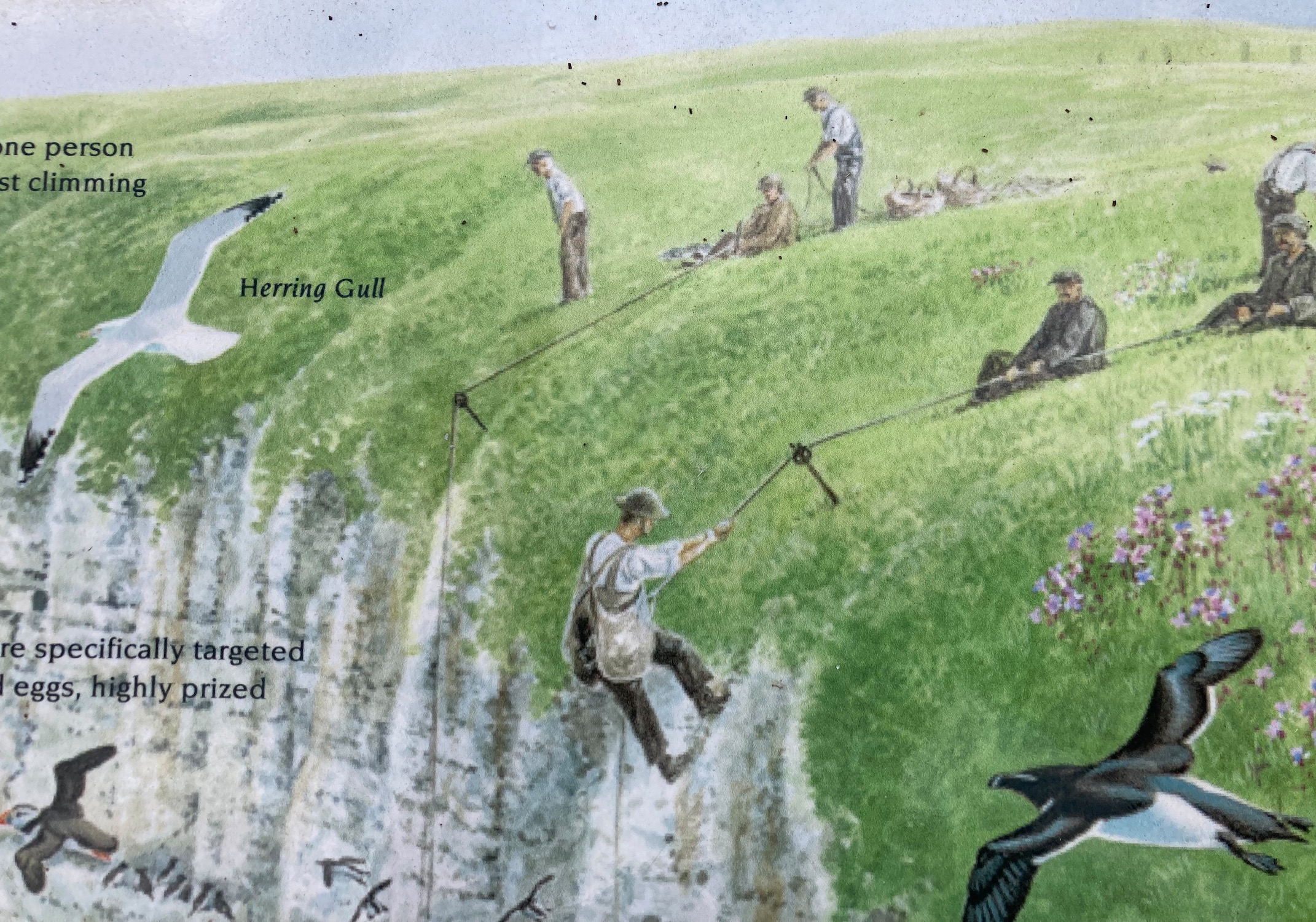

It brings to mind the St Kildans, the ‘bird people’ who also abseiled cliffs (and climbed up sea stacks) to collect gannet and fulmar eggs, or in their case, also to capture fulmars to eat and milk their oil. Sadly, the St Kildans could not sustain their way of life and asked to be evacuated by the British Government who agreed and they abandoned the island in 1930. This is the official story – I think the jury is still out as to whether they went willingly or were forced to leave.
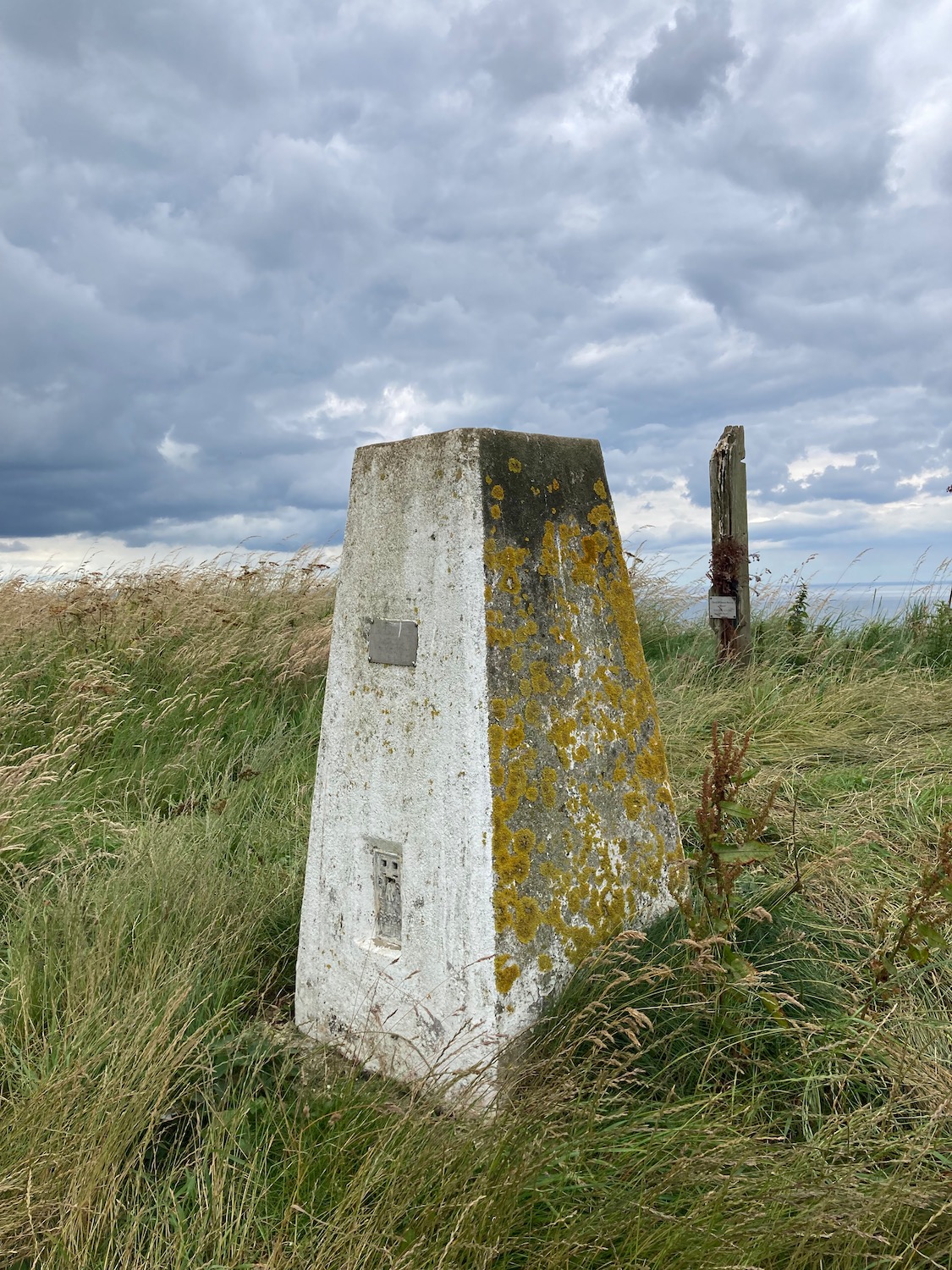
But it’s time to move on – by now we are a little peckish and although we pass quite a few benches, there are still too many people around. The path now leads us away from the cliff edge, winding round in a loop called Low Fields. After what seems like a very long time we decide to stop for lunch at the next half acceptable spot, which happens to be a triangulation point – the highest point for miles around – although it doesn’t feel very high.
Moving on after a very welcome lunch (food always tastes better when eaten outdoors) we find ourselves in a very different landscape and almost lose the path in fields of swaying corn.

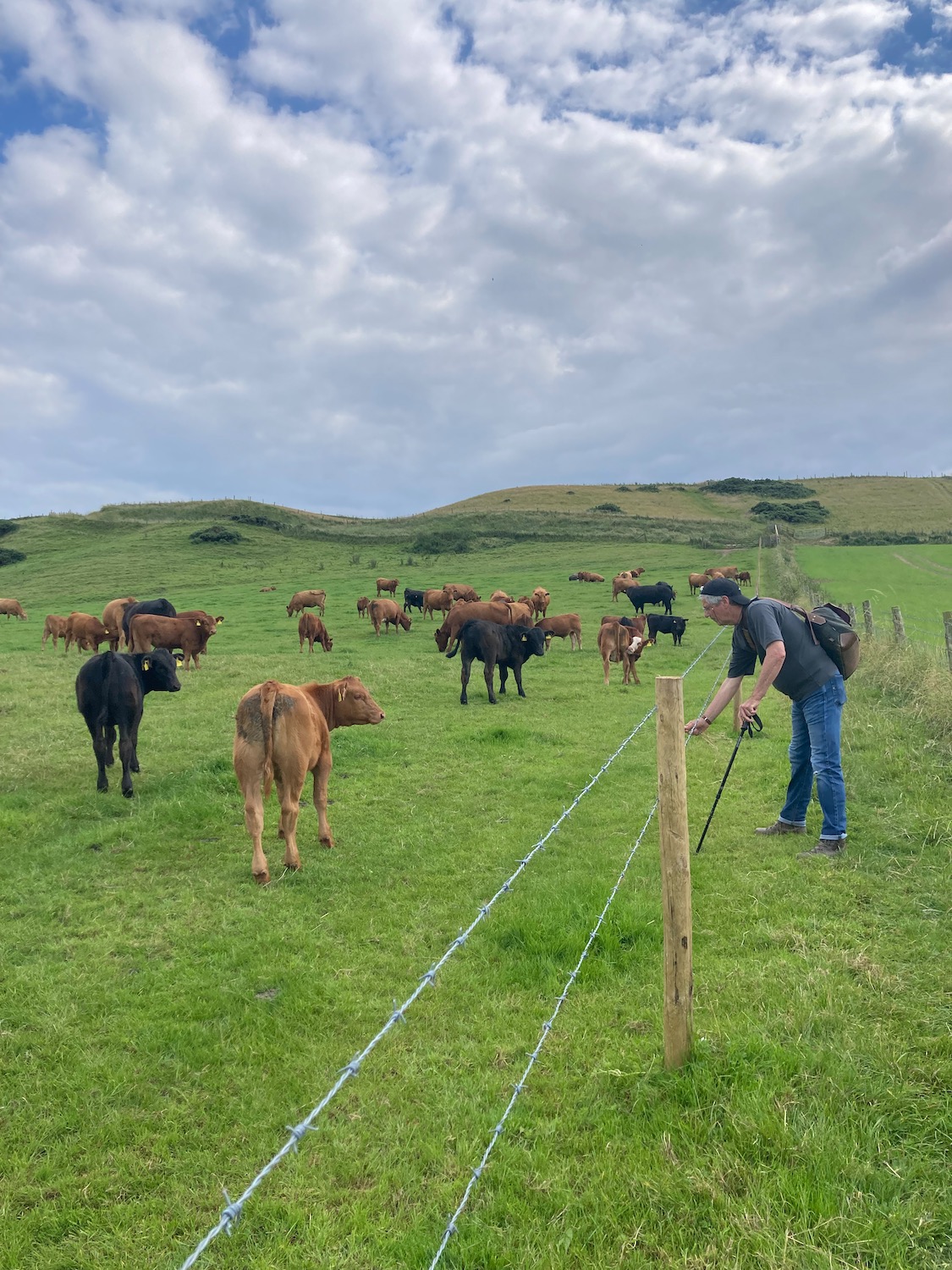
But then it becomes clearer…………….here is Damian talking to the animals again, problem is they never seem to want to talk to him.
And confirmation of the path – this signpost hasn’t got round to including King Charles and probably never will.

Half a mile on we veer off the path and wander through the caravans of Reighton Sands Holiday Park until we reach the very spot where I finished my walk from Filey a few days ago. The tractor and trailer stand ready to transport people down to the beach but it’s now late in the day so there are not many takers.

Distance: 9 miles
Seven years ago (and they went quickly) we set out to walk from Scarborough to Robin Hood’s Bay but only made it to Ravenscar. So this short walk is just to join a couple of dots.
Continue readingFiley is a 20 minute bus ride from Scarborough station and costs me next to nothing – and if I hadn’t lost my freedom pass in Grimsby it would be nothing. That aside I am taking full advantage of the £2 bus fare cap scheme brought in by the Conservatives (would you believe) and due to run out in December this year. It appears to apply all over England and Wales except in London, Greater Manchester and West Yorkshire, who all have their own schemes.
Continue readingWe arrived in Scarborough yesterday and can’t wait to leave. I have booked two nights in The Grand Hotel, an enormous Victorian building that presides over the harbour and the beach – the nightly rate is reasonable and I quickly realise why.

Our taxi drops us off close to Stone Creek House and we get a cheery welcome from a couple of people outside – the outer buildings seem to house both a boat club and a caravan site. The creek also has the remains of its own anti-aircraft battery in a field behind the house but this is closed to the public.
Continue readingPaull is a sleepy village roughly five miles outside of Hull as the crow flies, but as we are not crows and because there is a dirty big patch of dockland and chemical works in the way, our walk turns out to be considerably longer. We leave the car in St. Andrews Quay where we stopped yesterday
Continue readingThis is the day we leave Lincolnshire behind – yes!
Starting in New Holland we leave the car opposite the charming community centre, pull on our boots and head once again for the sawmill.
As we are based in Grimsby we’ve had a good look round and oh dear………Grimbarians have a lot to put up with. There are apparently a few historic buildings, but the only one we see houses Wetherspoons – the rest of the town centre consists of empty boarded up shops and unloved public space. I had previously surmised that the Vikings had named the town “grim” meaning “ugly” and “by” meaning “town” but it was of course another era. Google has another theory: “The name Grímr is common across the Scandinavian world and recorded several times throughout Lincolnshire in the Domesday Book. According to legend, Grimsby was founded by a Danish fisherman called Grim. In Old Norse, ‘by’ means village.” I still prefer my own theory……………………
Continue readingThe planning of this walk was as arduous as the walk itself, the two challenges being the enormous expanse of Immingham and Grimsby Docks. Trying to keep as close to the coast as possible is problematic when both of these areas do not take kindly to unauthorised visitors on foot. We did our best…….
Continue reading Joining the Dots